
CBD Oil vs Gummies
Updated
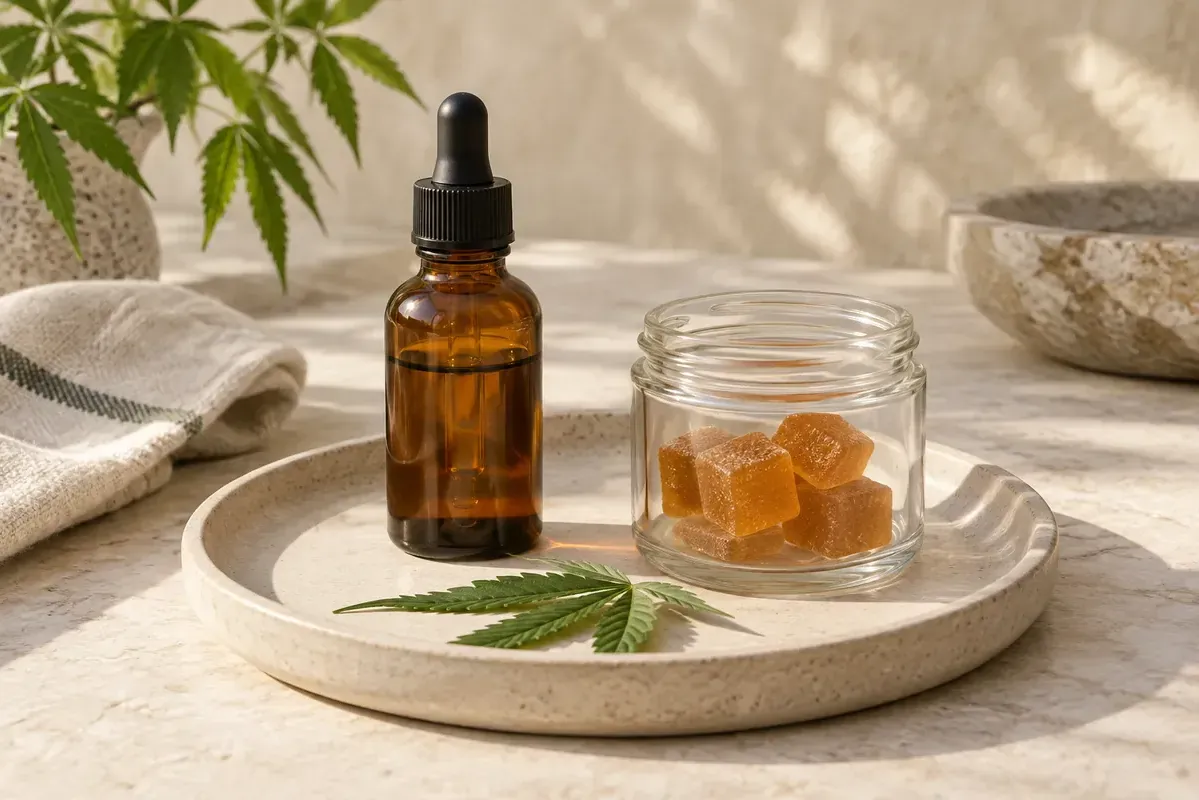
Illustrative oil and gummy formats, without brand, potency, or effectiveness claims.
Quick answer / TL;DR
CBD oil is usually better if you want flexible dosing, faster adjustments to your routine, and a simple ingredient profile. Gummies are usually better if you value convenience, portability, taste, and pre-measured servings.
| Best for | Choose CBD oil | Choose CBD gummies |
|---|---|---|
| Fine-tuning CBD dosage | Yes | Limited |
| Travel and discretion | Good | Excellent |
| Avoiding added sugar | Usually easier | Check label |
| Consistent serving size | Requires measuring | Yes |
| Beginner simplicity | Moderate | Excellent |
| Faster routine feedback | Often easier | Slower and steadier |
| Stronger value per mg | Often | Sometimes |
Neither format is automatically stronger. The better choice depends on CBD per serving, extract type, lab reports, tolerance, and consistency.
What is CBD oil?
CBD oil blends a liquid hemp extract with a carrier such as MCT, hemp seed or olive oil. Most bottles come with a dropper. You may also see them sold as "tinctures": brands often use the two names interchangeably, even though many modern tinctures use oil instead of alcohol.
A dropper lets you measure smaller servings, make gradual changes or split an amount between morning and evening. That control can help when you are new to CBD or comparing strengths. With full spectrum oil, changing the serving also changes your exposure to trace THC.
CBD oils may be:
- Full spectrum: Contains CBD plus other hemp compounds and legally compliant trace THC when hemp-derived.
- Broad spectrum: Contains CBD and other hemp compounds, typically with THC removed or non-detectable by the lab method used.
- CBD isolate: Contains CBD without the wider hemp profile.
What are CBD gummies?
CBD gummies are edible pieces infused or coated with CBD. Each piece lists a set amount, so you can track a serving without counting drops.
They are easy to carry and need no measuring, with a familiar taste and texture. Smaller adjustments are harder: if a gummy contains 25 mg, reducing that amount may mean cutting the piece in half.
Gummies can contain sugar, sweeteners, gelatin, pectin, colors, flavorings, melatonin, botanicals, or other active ingredients. That makes it important to read the label.
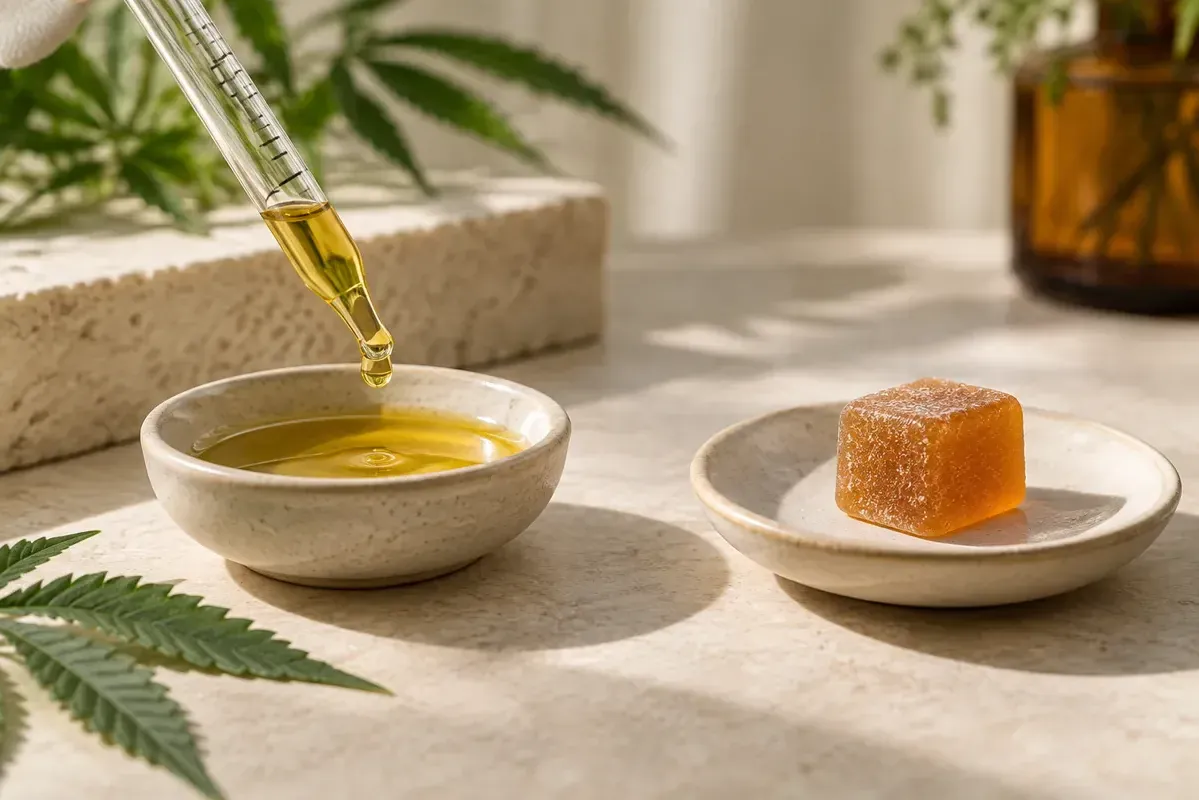
Illustration of liquid and fixed-piece formats; the portions are not shown as equivalent doses.
CBD gummies vs oil: key differences
| Factor | CBD oil | CBD gummies |
|---|---|---|
| Dosing style | Adjustable by dropper | Fixed per piece |
| Absorption path | Held under tongue or swallowed | Digested like an edible |
| Onset feel | Often easier to assess sooner | Usually more gradual |
| Duration | Varies by dose and person | Often longer-feeling routine window |
| Taste | Hemp-forward unless flavored | Sweet, candy-like |
| Ingredients | Often CBD extract plus carrier oil | More ingredients |
| Portability | Bottle can leak or break | Very portable |
| Cost efficiency | Often lower cost per mg | Often higher cost per mg |
Think about how you will use the product. Oil leaves room to adjust a serving; a gummy gives you the same listed amount each time. One may be easier to keep using than the other.
CBD absorption, bioavailability, and effects
CBD absorption rates vary because the body handles oils and edibles differently. Many people hold CBD oil under the tongue before swallowing. Some CBD may be absorbed through mouth tissue, while the rest is digested.
With gummies, CBD passes through digestion and the liver before reaching circulation. This can feel slower, but the format may suit people who take CBD with breakfast, after dinner, or before bed.
Food, metabolism, product quality, dose, and extract type can influence CBD bioavailability. Compare products under similar conditions; for example, do not compare oil taken on an empty stomach with a gummy taken after a heavy meal.
CBD oil dosage vs CBD gummies dosage
CBD oil dosage is flexible because you can adjust the amount by fractions of a dropper. For example, a 30 ml bottle with 1,000 mg of CBD contains about 33 mg per ml. A quarter dropper would contain roughly 8 mg, assuming accurate markings.
A jar labeled 20 mg per gummy makes the amount in a whole piece clear. It leaves less room for small adjustments than a measured oil serving.
When trying a product:
- Start with a low serving, especially if you are new to CBD.
- Use the same serving at the same time of day for several days.
- Track sleep quality, mood, discomfort, alertness, and side effects.
- Increase only when you understand how the current serving feels.
- Speak with a healthcare professional if you take prescriptions, have liver concerns, are pregnant or breastfeeding, or are managing a medical condition.
CBD is not risk-free. The CDC notes possible effects such as drowsiness, diarrhea or appetite changes, mood changes, liver concerns, and drug interactions. The FDA has approved one prescription CBD medicine, but not most retail CBD products for disease claims. CDC, FDA
Benefits and drawbacks
CBD oil benefits
- Flexible serving size for beginners and experienced users
- Easier to compare low, moderate, and higher servings
- Often fewer non-active ingredients
- Usually strong value per milligram
- Available in full spectrum, broad spectrum, and isolate formulas
CBD oil drawbacks
- Dropper measuring can be inconsistent
- Hemp flavor may bother some users
- Less convenient in public
- Bottles can leak during travel
- Full spectrum oils may contain trace THC, so lab reports matter
CBD gummies benefits
- Pre-measured CBD dosage
- Easy to take discreetly
- Better taste for most users
- Simple for travel, work, and daily routines
- Familiar format for beginners
CBD gummies drawbacks
- Less dosing flexibility
- More likely to contain sugar or additives
- Slower edible-style absorption
- Can be mistaken for candy, so child-safe storage is essential
- Often more expensive per mg of CBD
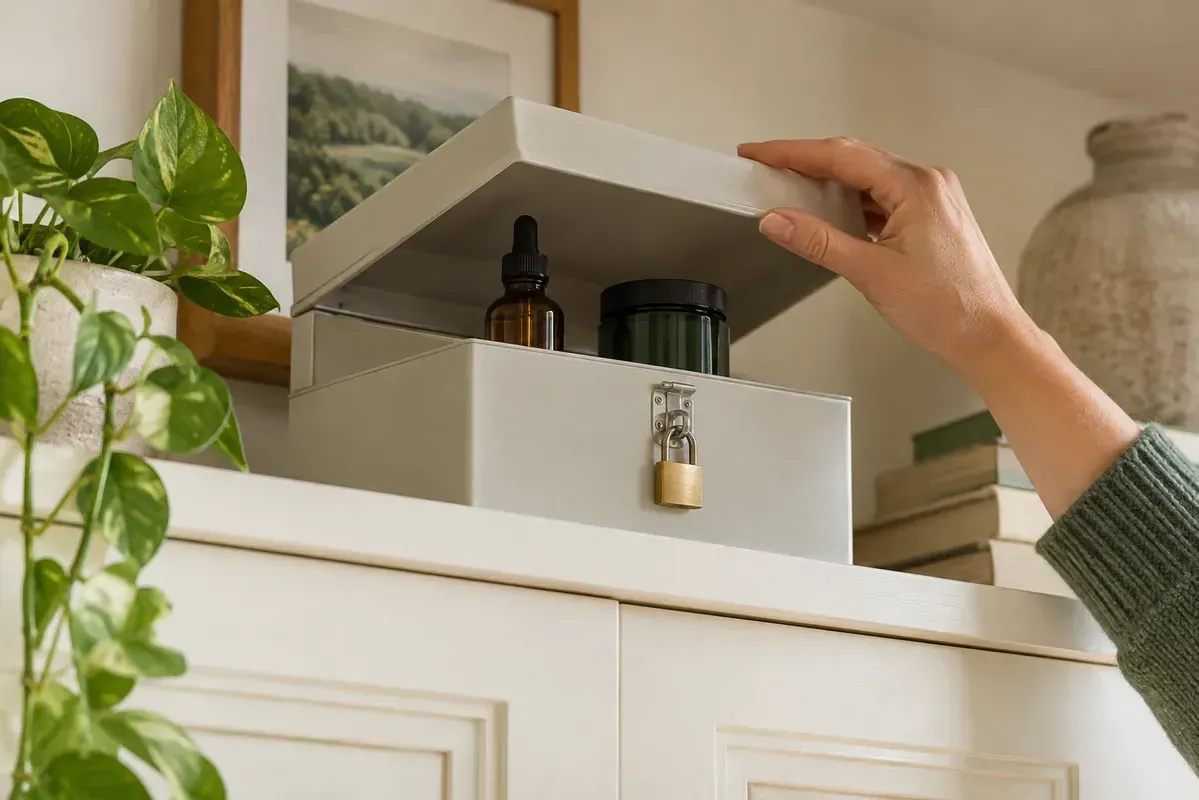
Illustration of secure storage for adult products.
Which is better for sleep, anxiety, and daily wellness?
Gummies are popular in evening routines. Oil may suit you better if you want to adjust the serving or avoid a sleep blend containing melatonin or herbs.
People considering CBD for anxiety or daytime stress may prefer the smaller serving adjustments possible with oil. Gummies can fit daily use, though the slower edible format is less convenient when timing matters.
For general wellness, choose the format you can use consistently and safely.
CBD products should not replace professional care for anxiety disorders, sleep disorders, chronic pain or other conditions. NIH's NCCIH advises discussing complementary approaches with healthcare providers and not postponing medical care. NCCIH
How to choose between CBD oil or gummies
Compare listed CBD oils and CBD gummies by label details after choosing a format.
| Your priority | Better fit | Why |
|---|---|---|
| You are brand new to CBD | Gummies or low-strength oil | Gummies are simple; oil is easier to fine-tune |
| You want the cleanest label | Oil | Often fewer ingredients |
| You dislike hemp flavor | Gummies | Better taste masking |
| You want full dosing control | Oil | Smaller adjustments are possible |
| You travel often | Gummies | No liquid bottle or dropper |
| You compare price carefully | Oil | Often better cost per mg |
| You want a steady habit | Gummies | Pre-measured and easy to repeat |
If both formats appeal to you, decide whether measuring and adjusting a serving matters more than carrying a ready-to-use piece.
Buyer checklist: what actually matters
CBD gummies and oils have more in common than their formats suggest. Check:
- Find a recent third-party lab report covering CBD, THC and contaminants.
- Compare milligrams per dropper or gummy as well as the total in the package.
- Check the extract type: full spectrum, broad spectrum and isolate differ in THC and other hemp compounds.
- Read the ingredients for allergens, sugar, gelatin, artificial colors, melatonin and botanicals.
- Divide price by total CBD milligrams to compare cost per mg.
- Look for clear labels and batch numbers, realistic claims and a way to contact the brand.
- Check state rules and any workplace or travel restrictions involving THC.
Avoid products that promise to cure disease, hide lab reports, list "hemp extract" without CBD milligrams, or make the label hard to understand.
Common mistakes to avoid
- Assuming every CBD product is free of THC. Full spectrum can contain trace amounts.
- Changing the dose so quickly that you cannot judge the effects.
- Overlooking melatonin in sleep gummies or herbs in calm formulas.
- Choosing the lowest package price without checking how much CBD it contains.
- Leaving gummies where children or pets can reach them. Store them as you would any adult supplement.
- Expecting oil and gummies to feel identical despite differences in timing, ingredients and serving control.
Frequently asked questions
Are CBD gummies better than oil?
CBD gummies are better for convenience, taste, and pre-measured servings. CBD oil is better for flexible dosing, fewer ingredients, and precise adjustments.
Does CBD oil work faster than gummies?
CBD oil may be easier to evaluate sooner when held under the tongue before swallowing. Gummies depend more on digestion, meal timing, and metabolism.
Is CBD oil stronger than gummies?
Not automatically. Strength depends on CBD per serving, product quality, extract type, and absorption. A high-dose gummy can contain more CBD than a small oil serving.
Can I take CBD oil and gummies together?
You can combine formats, but count the total CBD from both products and avoid casually stacking servings. If you take medication, ask a healthcare professional first.
What is better for beginners: CBD tincture or gummies?
Gummies are simpler because each serving is pre-measured. A low-strength CBD oil is better if you want to start very small and gradually adjust your serving size.
Are full spectrum CBD oil and full spectrum gummies different?
They can contain similar hemp compounds, but the format affects dosing precision, ingredients, taste, and absorption path. Always check the lab report for CBD amount and THC content.
Will CBD gummies or oil show up on a drug test?
CBD itself is not usually the target of standard THC drug tests, but full spectrum products may contain trace THC. Because product labeling can vary, avoid THC-containing CBD products if drug testing is a concern.
How do I compare CBD value?
Divide the price by total CBD milligrams. Then compare lab testing, ingredients, extract type, and serving size. The cheapest price is not always the best value.
Conclusion
Oil gives you more room to adjust a serving and often has a shorter ingredient list. Gummies are easier to carry and offer a pre-measured amount in a sweeter format. Whichever you prefer, check the CBD amount and lab results, read the claims carefully, and plan how to store it safely.
Related CBD guides
How to choose CBD strength
Distinguish package totals, concentration and CBD per serving.
Full spectrum vs broad spectrum CBD
Understand spectrum labels and questions about THC content.
CBD dosage considerations
Read about serving amounts, individual factors and dosage questions.